How to Choose a Wooden Toy Manufacturer for Pretend Play Products
- Share
- publisher
- KIDMERRY
- Issue Time
- Oct 13,2026
Summary
A buyer's guide to choosing a wooden toy manufacturer for pretend play: what to fix in your sourcing brief, how to compare CNC and finishing capability, which certificates to read by scope, the 10-point factory checklist to send, and the sampling, packaging and lead-time terms to get in writing.
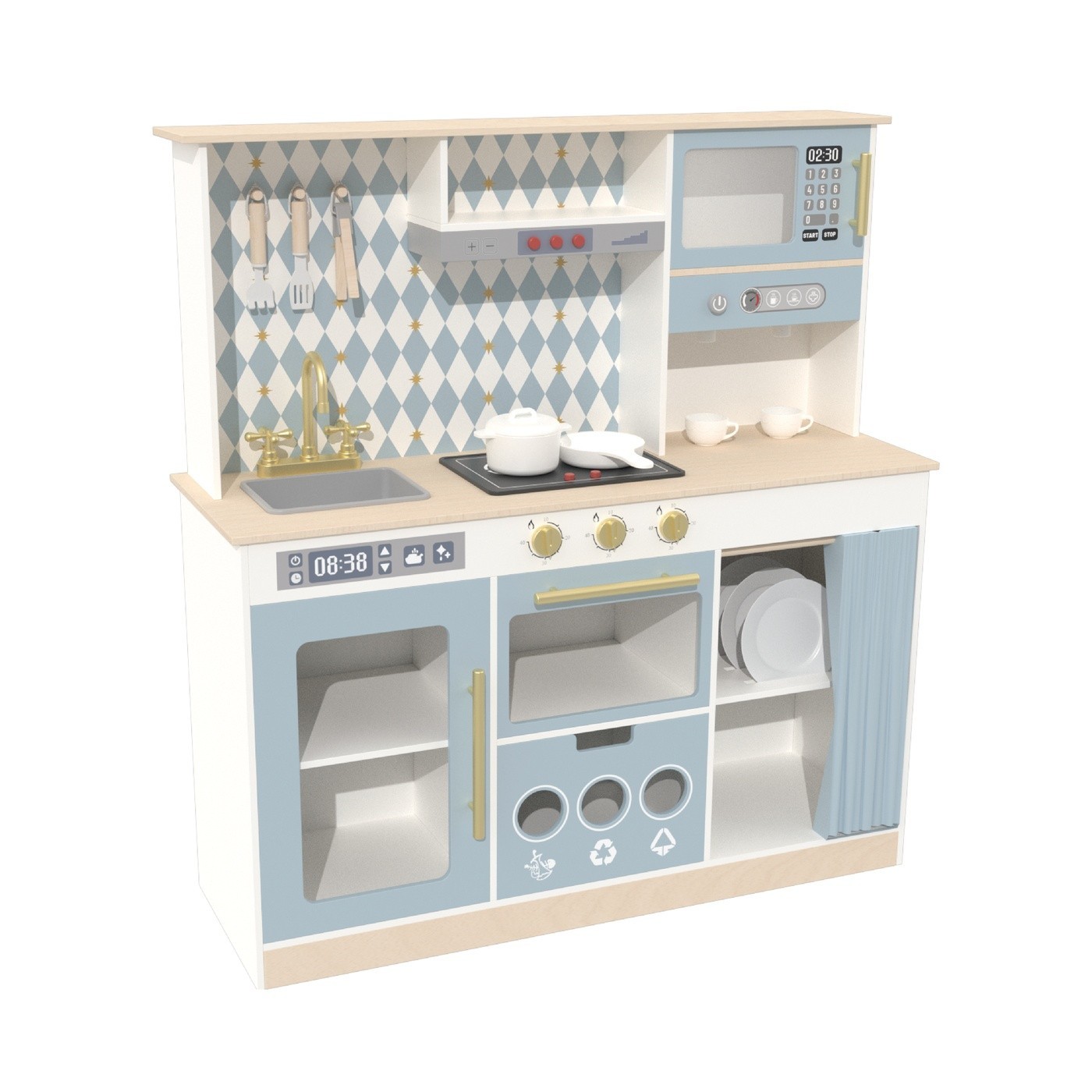
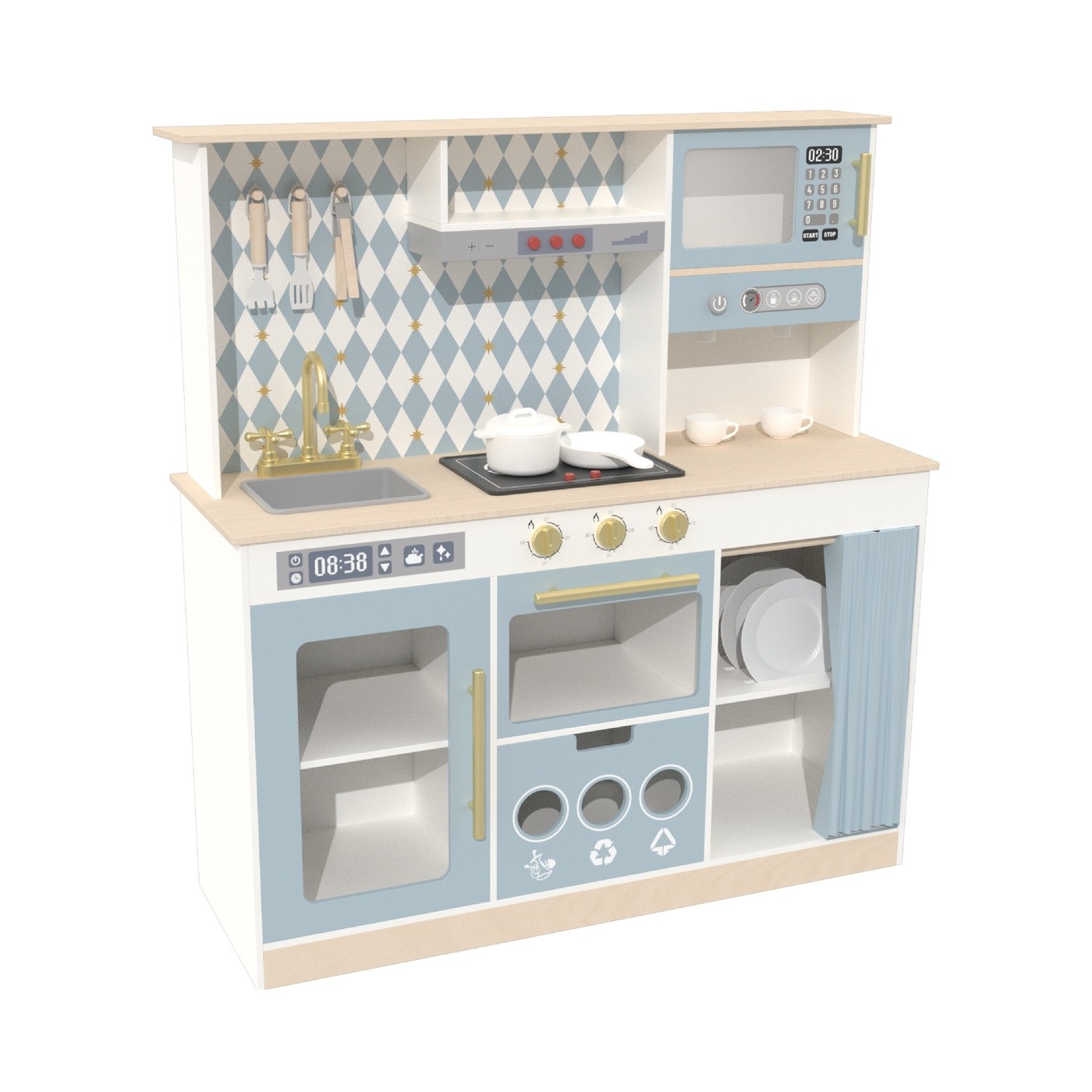
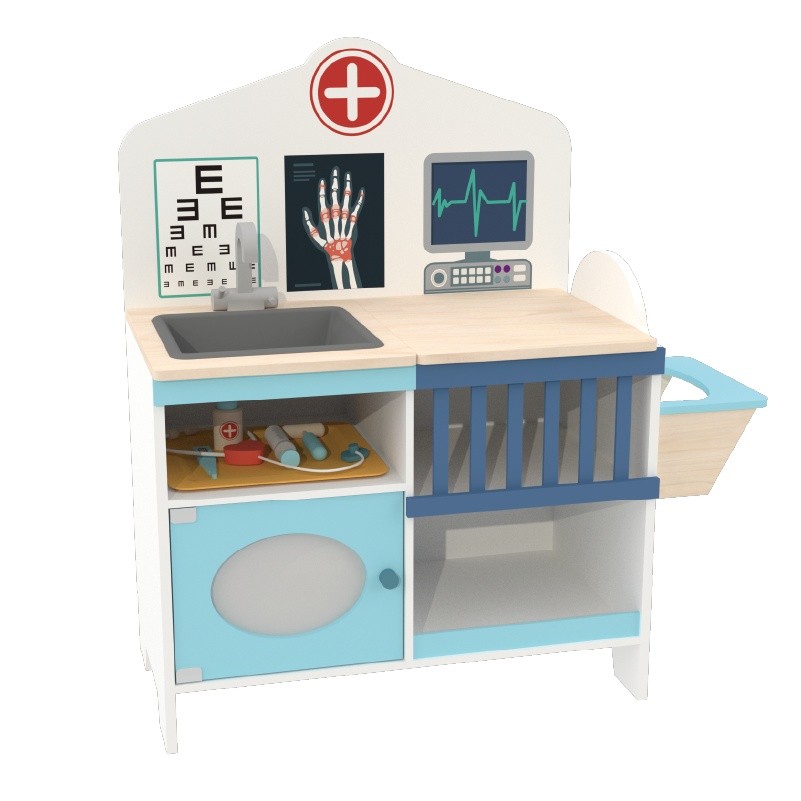
Choosing a wooden toy manufacturer is usually treated as a pricing exercise. For pretend play products it rarely should be. A play kitchen, a foldable doll house or a doctor's station is a multi-part assembly — panels, doors, hinges, knobs, printed artwork, an accessory set, and a carton that has to survive a container. The failure modes that actually cost buyers money are almost always engineering and process problems, not negotiation problems.
This guide is written for brand owners, importers and procurement teams who are shortlisting an OEM wooden toy manufacturer or auditing an existing pretend play toy supplier. It follows the real sequence of a sourcing decision: what to define before you ask for a price, which capabilities to compare, how to read compliance paperwork, and what to settle in writing before you pay for a sample.
KIDMERRY builds pretend play products, so where we describe our own capability we say so and keep it to what we can evidence; where a point is general industry practice, we say that too. Anything market-specific — your age grade, your market's chemical limits, your labelling language — should be confirmed against your own product specification and the rules where you sell.
Why Manufacturer Selection Matters More in Pretend Play Than in Most Categories
Pretend play products are assemblies, not single parts
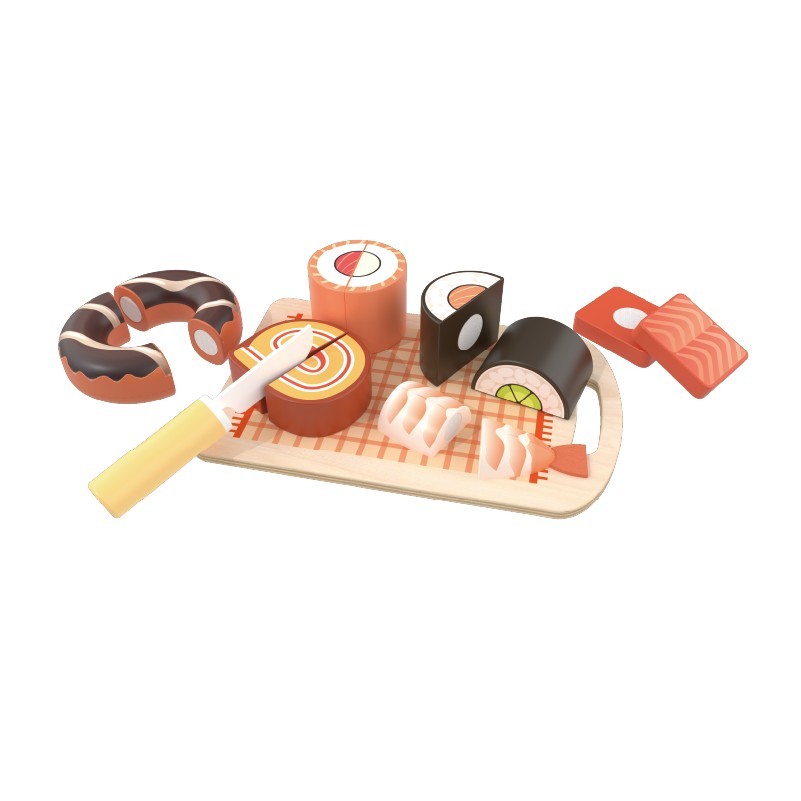
A stacker or pull-along toy is largely one body, one finish and one carton. A pretend play SKU is closer to flat-pack furniture in miniature. One play kitchen can combine cabinet panels, an oven door with hinge and magnetic catch, a sink insert, knobs, a blackboard, printed graphics, and ten to thirty loose accessories — cutting food, utensils, pots, a shopping list. Each is a separate tooled or sourced item with its own tolerance, finish and packing count.
So you are not buying "a wooden toy". You are buying a factory's ability to hold alignment across parts, repeat a colour across batches, keep an accessory count stable, and pack a mixed set with nothing missing. A supplier excellent at single-body wooden toys can still be wrong for a 96 cm refrigerator with two doors.
The cost of a wrong choice shows up late
Mistakes in this category surface after the money is committed. Doors drop out of alignment at assembly, not in the sample photo. Colour drift shows when the second container lands beside the first on a shelf. Missing accessories show up as retail returns, and under-specified cartons as corner crush. None of this is visible in a showroom or a quotation — which is why the evaluation has to rest on process evidence, not samples alone.
What to Check Before You Request a Quote
Most weak sourcing outcomes start with a weak brief. Send three factories "play kitchen, please quote" and you will get three incomparable numbers, because each silently assumes a different panel thickness, board grade, hinge type, accessory count and carton spec. Fix the brief first.
Define the product architecture before the price
Write down, in one page, what drives cost and risk:
- Dimensions and age grade — counter height, footprint, and the band you will label for. Age grade drives small-part rules, warnings and, for the US, whether third-party testing and certification apply.
- Panel construction — solid wood, multi-ply plywood or MDF, and thickness for load-bearing panels versus backs and shelves.
- Moving parts — how many doors, drawers, hinges, latches, knobs and wheels, and the cycle life you expect.
- The accessory set — itemised with quantities. This is the single most common source of cost drift between quotation and production.
- Artwork and branding — printed, laser-engraved or applied; how many colours; where your logo sits.
- Packaging format — assembled, knock-down or flat-pack; retail colour box or brown carton; whether you need a parcel-rated carton for e-commerce.
- Test standard and market — which standard applies, and who issues the certificate in your name.
If you cannot specify all of this yet, say so and ask the factory to propose a baseline. A good manufacturer will suggest a construction and flag trade-offs rather than guess silently.
Set the commercial frame: MOQ, target cost and market
Minimum order quantity is where expectations most often break. Treat any single round number quoted across a whole catalogue with suspicion: MOQ here is driven by changeover time, board yield and component sourcing, and a 30-piece accessory kit does not behave like a 96 cm cabinet.
As a reference point for your own brief, this is how KIDMERRY structures it: standard MOQ is 500 pieces per style for large structural products — doll houses, play kitchens, outdoor climbing frames — and for all-wood designs; products with a high share of plastic components, and small-item designs, start at 1,000 pieces per style. Final MOQ is confirmed per project. Note the unit: per style, not per order — the two are routinely confused, and the confusion quietly doubles or halves a programme.
Alongside MOQ, state your target landed cost band and peak-season window. A factory that knows you must be on shelf in September plans differently from one assuming you are filling a warehouse in March.
How to Compare Production Capabilities
Machining and structural capability
This is the section most buyers skip, and it best predicts whether a complicated pretend play product will work. Ask how panels are cut, how slots, tenons and snap-fits are formed, how hinge seats and door reveals are held consistent, and how safety radii are produced — a dedicated routing pass, or hand sanding afterwards. Hand-finished radii are the usual reason edge quality varies between batches.
To show the level of detail worth asking for: KIDMERRY runs an in-house CNC workshop with multi-head wood routing centres — twin-spindle machines and multi-tool auto-change engraving machines — on central dust extraction. We cut panels, profile irregular shapes, machine slots, tenons and snap-fits, engrave relief patterns and mill safety radii in a single pass, holding machining tolerances of ±0.1–0.2 mm. DXF and STL files are accepted for sampling; hand sketches can be modelled into toolpaths; sanding, painting and assembly are done in-house. That tolerance is a machining capability, not a finished-part guarantee — make any supplier distinguish the two, because the gap matters once parts must fit after finishing. We document this on our wooden toy manufacturing capability page.
Wood species and board options
Ask for the actual material list, not a category. Common options include beech, maple, birch, basswood, pine, multi-ply plywood and MDF — the materials KIDMERRY works with routinely. The right choice depends on what the part does: a hinge-bearing cabinet panel, a painted door front, a laser-engraved name panel and a small turned accessory all want different things from the substrate.
Two practical points. If you need certified material, ask for it explicitly — FSC-certified boards at KIDMERRY are available on request rather than by default, and you should confirm the certificate scope covers your specific SKU. And treat precise hardness or density figures with caution: published values vary by origin, grade and moisture content, and unless the factory cites a test report for the lot you are buying, the number is decoration. What you can reasonably ask for is species, grade, moisture content target and board certification for face and core.
Surface finish and colour systems
Finishes are where pretend play products are won or lost at retail, because these are large, highly visible painted surfaces. Ask which coating system is used, whether it is water-based, how many coats, whether spraying happens in a controlled booth, and — critically — how colour is specified and verified. A factory that matches to a physical standard and retains a signed reference panel will hold colour across repeat orders; one that matches by eye will not.
Then ask how the finish is tested for the use it will see: rub and adhesion on a door edge opened fifty times a day, scuff resistance between stacked panels, and colourfastness if the product is marketed as washable or for outdoor use. For any part a child may mouth, the coating is part of the chemical compliance story, not a cosmetic detail.
Shape, Structure, Colour and Artwork: Where the Specification Becomes Real
Shape and structure
Structural decisions should be reviewed as a system, not part by part. A foldable doll house has very different demands from a fixed one: hinge geometry, panel swing clearance, fold-flat thickness, and whether the folded unit still protects its own printed surfaces in transit. A blackboard changes the panel spec behind it; a second door changes the alignment stack-up across the whole front face.
Ask the factory to walk you through the real use sequence — opened, folded, loaded, dropped — and what they test to confirm it. Suppliers who have made the category before will have opinions here, and those opinions are more informative than any certificate.
Colour, print and artwork control
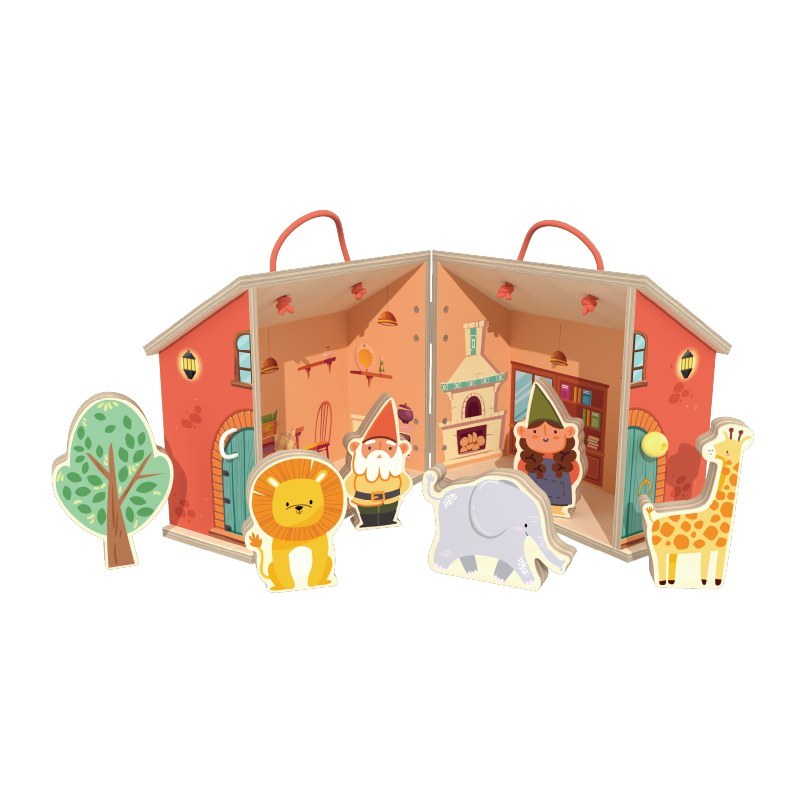
Settle these before sampling. How many Pantone references are in the design; whether they are matched on wood, on board, or both (they will not look identical); whether printing is pad, screen, UV or laser; the artwork file requirements; and who owns the plates or screens. Ask whether a signed-off colour standard is retained per SKU and whether reorders are matched against it.
For private label buyers, this is also where you confirm what can carry your brand: carton print, header cards, instruction sheets, labels, and any moulded or engraved part. If you are launching on an existing design rather than developing from scratch, our private label wooden toy manufacturer programme covers that route, and it is a different commercial conversation from OEM development.
Age grading and play pattern
Age grading is a compliance input, not a marketing afterthought. It drives small-parts assessment, warning and labelling text, the test standard applied, and in several markets whether third-party testing and certification are triggered at all. Pretend play straddles an awkward range — a play food set with small pieces and a 96 cm kitchen cabinet sit at very different points on that scale, even under one brand.
Be explicit about the band you intend to print, and ask whether the design as drawn supports it. If your designer wants 3+ and the accessory set will not pass a small-parts assessment for that band, you want to know during sampling, not during testing.
Quality Control, Testing and Certification: Read the Scope, Not the Logo
This is where buyers are most often misled, usually by perfectly truthful documents that are read too broadly. A certificate tells you something about a system, a site, an audit date or a specific tested sample. It rarely tells you that your SKU is compliant. Read the scope.
Product safety standards: EN 71, ASTM F963 and CPSIA
For the EU, Toy Safety Directive 2009/48/EC sets essential safety requirements covering physical and mechanical properties, flammability, chemical properties, electrical safety, hygiene and radioactivity. The technical detail sits in harmonised standards developed by CEN and CENELEC and published in the Official Journal — the European Commission maintains the consolidated reference list, currently under Implementing Decision (EU) 2023/740 as amended. EN 71-3 is the part covering migration of certain elements.
Plan for one change. The EU adopted Regulation (EU) 2025/2509 on the safety of toys, published in the Official Journal on 12 December 2025, repealing Directive 2009/48/EC. It entered into force on 1 January 2026 and, per the European Commission, applies from 1 August 2030 after a four-and-a-half-year transition, introducing a digital product passport and extended chemical restrictions. The Directive's requirements remain what you design and test to today — but a supplier who cannot discuss the transition coherently is not tracking your market.
For the US, ASTM F963 is mandatory under CPSIA section 106(a), codified at 16 CFR part 1250; the mandatory edition is ASTM F963-23, required for toys manufactured on or after 20 April 2024. Two details matter: section 4.2 (flammability) and Annex 5 are excluded under 16 CFR 1250.2(b), and the applicable edition is tied to manufacture date, not import date. Separately, CPSIA sets a 100 ppm total lead limit in accessible parts, 90 ppm on paint and similar coatings under 16 CFR part 1303, phthalate restrictions at 0.1%, and permanent tracking labels. The Children's Product Certificate (CPC), based on testing at a CPSC-accepted laboratory, is issued by the importer or domestic manufacturer — not the overseas factory. Confirm current certificate content and filing requirements with CPSC when you order, as these have been revised recently.
Management-system, social-compliance and chain-of-custody documents
Keep these in a separate bucket from product safety. ISO 9001:2015 is a quality management system certification; BSCI and Sedex (SMETA) are social compliance audits; FSC chain-of-custody tracks certified material through processing and trade. None is a product safety certificate, and a supplier presenting them as such either misunderstands them or hopes you do.
For reference, KIDMERRY's documentation covers EN 71-3 (migration of certain elements), ASTM F963 and CPSC requirements for the US market, ISO 9001:2015 quality management, BSCI and Sedex (SMETA) social compliance audits, and FSC chain-of-custody for wood. Test reports are issued per product and per order. Our FSC chain-of-custody scope covers wooden children's toys, wooden building blocks, wooden educational aids, wooden crafts and wooden packaging boxes, plus the processing and sale of matching paper gift packaging boxes — check that the scope covers the specific SKU you are buying.
Questions to Ask Before Sampling: A Wooden Toy Factory Checklist
Below is a working checklist you can send to any candidate. It is deliberately written so that vague answers are visible as vague answers. A factory that has done this before will answer most of it without a follow-up email.
| Area | Question to put in writing |
|---|---|
| Structure & tooling | How are hinge seats, door reveals and snap-fits held consistent across a run? Is there new tooling, and who pays for it and owns it? |
| Machining | Which operations are CNC and which are manual? What tolerance is held at machining, and separately, what is guaranteed on the finished, assembled part? |
| Materials | Exact species or board grade per part? Moisture content target? Is certified board available, and does the certificate scope cover this SKU? |
| Finish | Which coating system, how many coats, applied where? How is colour specified, and is a signed reference panel retained per SKU? |
| Small parts & age | What age grade does this design support as drawn? Which parts drive that assessment? |
| Testing | Which standard will this specific product be tested to, by which lab, and will the report name this product? |
| QC | What is inspected, at what stage, at what AQL, and what records can I see? Can I appoint a third-party inspector? |
| Accessories | How is the accessory count controlled and verified at packing? What happens if a component is short? |
| Packaging | Carton grade, construction, drop-test evidence, and whether the pack is rated for retail shelf or parcel shipment. |
| Commercials | MOQ per style, sample cost and lead time, mass production lead time after approval, Incoterms, payment terms, and the name on the certificate. |
Timelines, packaging and export
Three items belong in the written quote. Sampling: at KIDMERRY, samples of existing designs typically take 7–10 working days, and samples developed from your drawings 15–20 working days, plus shipping — typical figures, not commitments. Mass production: quote lead time from sample approval rather than deposit; we plan about 30–45 days after approval, and 45–60 days in peak season, generally Q2–Q3, excluding freight and your own testing. Packaging and export: who prints the carton and at what minimum run, since print MOQs often exceed product MOQs, and the documentary set, including wood-packaging treatment — solid wood may require ISPM 15, while plywood and MDF are generally exempt.
Request a Wooden Toy Supplier Evaluation
Send us your drawing, photograph or a list of the SKUs you are comparing. We will come back with the construction proposal, the materials and the checks we would run, including where we think the design carries risk.
Request a wooden toy supplier evaluation →Planning a New Pretend Play Range?
Shortlisting a manufacturer is about a fair comparison — the same brief, the same construction assumptions, the same questions in writing, and documentation you verify rather than accept.
If you are at that stage with a wooden pretend play programme, we are glad to be one of the quotes you compare. KIDMERRY is a custom wooden toy manufacturer in Yunhe, working across play kitchens, doll houses, role play sets and their accessory programmes, with in-house CNC machining, finishing and assembly. Send us the brief and we will tell you the construction, materials and checks we would propose, and where we see risk — whether or not you order from us.
Contact KIDMERRY for Wholesale Supply
Tell us the product, the market, the age grade and the quantity. We will come back with a construction proposal, an MOQ per style, a sampling plan and a production window — plus the questions we still need before quoting.
Contact KIDMERRY →